

High Tide Aviation
Coastal Flight Training NC & GA: Year-Round Weather Advantage
When you choose where to earn your pilot’s license, the weather matters more than you might think. While flight schools in northern states face months of ice, snow, and canceled lessons, coastal flight training in North Carolina and Georgia keeps you in the air nearly every single day of the year.
High Tide Aviation operates three strategically located bases along the Atlantic coast: Southport, NC, Wilmington, NC, and St. Simons Island, GA. Each location offers unique training advantages that come from one powerful factor: consistent, flyable weather that accelerates your path from student to certificated pilot.
Your training timeline depends heavily on weather reliability. When you can fly consistently, you build muscle memory faster, retain knowledge better, and finish your certification sooner. Here’s why the coastal climate in NC and GA gives you that consistency.
Year-Round Flying When Northern Schools Shut Down
The difference between coastal flight training and inland programs becomes obvious in winter. Schools in states like Ohio, Illinois, and Pennsylvania often reduce operations from December through March. Ice on wings. Snow on runways. Wind chills that ground entire fleets.
Meanwhile, winter temperatures along the North Carolina and Georgia coast typically hover between 50°F and 70°F. Your lessons continue without interruption. You wear a light jacket instead of three layers. The aircraft flies predictably, and your training stays on schedule.
This matters for your wallet, too. When training drags across 12 or 18 months because of weather delays, you pay for currency flights just to stay proficient. Skills fade between lessons. You relearn concepts you already paid to master. Consistent coastal weather cuts that waste.
At High Tide Aviation, students train through all four seasons without losing momentum. The Part 141 certification we maintain means you already benefit from reduced hour requirements: 35 hours minimum for Private Pilot instead of the Part 61 standard of 40 hours. When you pair that with weather that rarely cancels lessons, you finish faster and spend less overall.
Three Strategic Locations, Three Distinct Training Environments
Each High Tide Aviation base offers different weather patterns and airspace complexity. This variety prepares you for real-world flying better than training at a single location ever could.
Southport, NC: Cape Fear Coastal Patterns
Southport sits at Cape Fear Regional Jetport (KSUT), a non-towered field where you learn uncontrolled airport operations in an area shaped by coastal wind patterns. The Cape Fear River meets the Atlantic here, creating predictable sea breezes that teach you wind correction and crosswind landings without the extremes that make training dangerous.
You practice pattern work in an environment that changes subtly throughout the day as thermal activity shifts. Morning flights feel different than afternoon sessions. You develop weather intuition naturally because you experience those variations consistently.
Wilmington, NC: Towered Operations with Coastal Diversity
Wilmington International Airport (ILM) adds Class C airspace and towered operations to your skill set. You communicate with air traffic control while managing the same coastal weather benefits that make Southport ideal for basic training.
ILM exposes you to controlled airspace procedures without the congestion and complexity of major metro airports. You learn radio discipline, clearance procedures, and transponder operations in a professional environment that still allows focused instruction time. The airport handles commercial traffic, so you practice real-world spacing and sequencing.
The coastal location means you fly in marine layer conditions, scattered sea fog, and onshore flow patterns that prepare you for instrument training. When you move into your Instrument Rating, you’ve already experienced the weather phenomena that challenge pilots in actual IMC.
St. Simons Island, GA: Subtropical Golden Isles Climate
St. Simons Island at McKinnon St. Simons Island Airport (KSSI) offers the warmest winter conditions of all three bases. The Golden Isles enjoy a subtropical climate where freezing temperatures are rare and flying season never truly ends.
This location serves students who want to train intensively without seasonal interruptions. The predictable weather supports accelerated programs like our Zero to Hero pathway, where you progress from zero experience to Commercial Pilot certification in a continuous timeline.
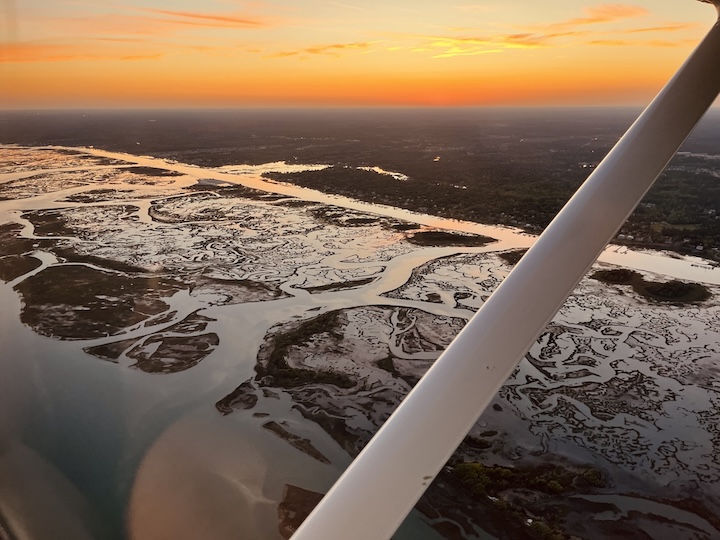
St. Simons also provides over-water navigation experience. You practice pilotage and dead reckoning with clear visual references: barrier islands, inlets, and coastal landmarks that teach you to read terrain the way experienced pilots do.
How Coastal Weather Accelerates Your Training Timeline
Training consistency matters more than raw talent. A student who flies three times per week in predictable weather will always outpace a student who flies sporadically because of canceled lessons.
High Tide Aviation’s three coastal locations give you scheduling flexibility that matches the reliable weather. When one base experiences temporary IFR conditions or low ceilings, another location 60 miles away often remains VFR. Your instructor can relocate your lesson rather than cancel it.
This geographic diversity also means you experience varied weather without waiting for seasons to change. Morning fog at Wilmington might clear by the time you fly to Southport for pattern work. Afternoon thunderstorms that develop inland rarely reach the immediate coast with the same intensity.
The result: more flight hours in your logbook per month. Faster skill development. Shorter time to checkride. Lower total cost because you’re not paying for months of stalled progress.
Students who train with us under Part 141 finish Private Pilot certification in as few as three to four months when they commit to regular lessons. The same timeline at a northern school often stretches to eight or twelve months once you account for winter shutdowns and spring mud season.
Real-World Weather Experience That Builds Confidence
Coastal flight training doesn’t mean you avoid weather challenges. It means you face them in manageable doses that build competence without creating danger.
You learn to read marine layers and predict when they’ll burn off. You practice crosswind landings with steady onshore winds instead of gusty, unpredictable turbulence. You navigate around pop-up coastal showers that teach weather avoidance without forcing you into severe convective activity.
This exposure matters when you earn your certificate and start flying independently. Pilots trained in artificially perfect conditions often feel unprepared the first time real weather disrupts their plans. You graduate with weather decision-making skills already tested in real scenarios.
Our fleet includes aircraft equipped with ADS-B, Garmin GPS systems, and glass cockpit displays that show real-time weather overlays. You learn to use these tools in actual coastal conditions, not just ground school hypotheticals. By the time you take your checkride, weather planning feels natural because you’ve done it dozens of times in real flight scenarios.
The Maintenance Advantage of Year-Round Operations
High Tide Aviation operates an in-house maintenance department staffed by FAA-certified mechanics. This setup reduces aircraft downtime and keeps our fleet of 12 aircraft mission-ready.
Consistent flying in mild coastal weather actually benefits aircraft systems. Engines that run regularly experience fewer corrosion issues than aircraft that sit idle through long winters. Our mechanics perform preventive maintenance on a predictable schedule because the aircraft accumulate hours steadily throughout the year.
You benefit directly: fewer canceled lessons due to mechanical issues. More aircraft availability when you need to schedule flights. Confidence that the plane you’re flying has been maintained by professionals who know its history.
The combination of reliable weather and reliable aircraft means your training progresses at the pace you set, not the pace that circumstances force on you.
Financial Impact: How Weather Affects Your Total Training Cost
Flight training represents a significant investment. Understanding how weather influences your total cost helps you make smarter decisions about where to train.
Consider two students with identical aptitude: Student A trains at High Tide Aviation in coastal North Carolina. Student B trains at a school in Michigan. Both aim for Private Pilot certification under Part 141, which requires a minimum of 35 hours.
Student A flies three times per week, year-round. Weather cancels roughly 10% of scheduled lessons. Training wraps in four months with 40 total hours (35 required plus 5 buffer).
Student B faces winter shutdowns from December through February. Spring weather in the Midwest brings unpredictable conditions. Training stretches to ten months with multiple currency flights needed after gaps. Total hours: 50, because skills deteriorated during breaks.
The difference: 10 hours at typical dual instruction rates equals $1,500 to $2,000 in additional cost. Student B also loses ten months of time that could have been spent building experience as a certificated pilot.
High Tide Aviation offers multiple financing options to make training affordable, including 529 Plan acceptance, partnerships with AOPA and Wurthy, and access to the North Carolina Tuition Assistance Program (NC-TAP) for eligible residents. When weather keeps you on schedule, these financing tools stretch further because you’re not paying for wasted months.
Comparison: Coastal vs. Inland Flight Training Climates
| Location Type | Average Flyable Days/Year | Winter Operations | Weather Consistency | Training Timeline Impact |
|---|---|---|---|---|
| Coastal NC/GA | 300+ | Full operations | High | Faster completion |
| Midwest | 220-250 | Reduced/suspended | Moderate | Extended timeline |
| Northeast | 200-230 | Suspended Dec-Mar | Low | Significant delays |
| Southwest | 320+ | Full operations | Very high | Fast, but limited real-weather exposure |
The table shows why coastal flight training in North Carolina and Georgia offers the optimal balance: year-round availability with enough weather variety to build real-world skills.
Beyond Private Pilot: Advanced Training in Coastal Conditions
The weather advantages that benefit Private Pilot students become even more valuable as you pursue advanced ratings.
Instrument training requires you to fly in actual IMC (Instrument Meteorological Conditions) to truly master the skills. Coastal weather in NC and GA provides controlled exposure to low ceilings, reduced visibility, and marine layers without the severe icing and convective threats common in other regions.
Our Instrument Rating program leverages this perfectly. You learn instrument approaches at Wilmington’s towered Class C airport. You practice holds and procedure turns in actual clouds over the ocean. You file IFR flight plans and execute them in real weather, not just simulated conditions under the hood.
Commercial Pilot training benefits from consistent weather because you need precision maneuvers that require calm conditions. Coastal mornings often provide glass-smooth air perfect for chandelles, lazy eights, and steep turns. By afternoon, thermal activity builds just enough to teach you energy management in real turbulence.
Multi-Engine students train in our Beechcraft Baron B55 aircraft year-round. Engine-out procedures require good weather for safety, but you also need enough real-world conditions to learn how twins perform in crosswinds and variable weather. The coastal climate provides both.
Why Pilots Relocate for Accelerated Coastal Training
Students from across the country choose High Tide Aviation specifically because of our coastal locations and weather reliability. They understand that relocating for three to six months to complete training continuously costs less than dragging certification across 18 months at a local school plagued by weather delays.
The Zero to Hero program illustrates this perfectly. You progress from zero flight experience through Private Pilot, Instrument Rating, and Commercial Pilot in a structured timeline. This only works when weather cooperates consistently.
Our Student Support Department helps relocating students navigate housing, transportation, and local resources. The investment in temporary relocation pays for itself through faster completion and lower total flight hours.
Many students also appreciate training in an environment they’ll actually enjoy. Southport, Wilmington, and St. Simons Island offer coastal beauty, recreational opportunities, and welcoming communities. Your training becomes an experience, not just a technical requirement.
Frequently Asked Questions About Coastal Flight Training
-
Can I really train year-round in North Carolina and Georgia?
Yes. Coastal NC and GA maintain flyable conditions nearly every day of the year. Winter temperatures stay mild, typically 50-70°F, and severe weather is far less common than in northern or Midwest regions. While occasional cold fronts or tropical weather may cause brief delays, you’ll experience consistent training access that northern schools simply cannot match from December through March.
-
How does coastal weather compare to Arizona or Southern California for flight training?
Coastal NC and GA offer more weather variety than the desert Southwest. While Arizona and Southern California provide even more VFR days annually, they lack the real-world weather exposure you need for complete pilot development. Coastal training includes marine layers, sea breezes, and actual IFR conditions that prepare you for flying anywhere in the country, not just perfect-weather destinations.
-
Will I get enough crosswind practice at coastal locations?
Absolutely. Coastal airports experience steady, predictable winds from onshore flow, sea breezes, and frontal passages. These winds teach crosswind correction techniques in manageable doses. Unlike gusty, turbulent inland winds that can overwhelm new students, coastal winds build your skills progressively while remaining safe and educational.
-
Does High Tide Aviation’s Part 141 certification work with the coastal weather advantage?
Yes, perfectly. Part 141 certification already reduces your required flight hours: 35 hours minimum for Private Pilot versus 40 under Part 61. When you combine that efficiency with weather that rarely cancels lessons, you complete training faster and at lower total cost than students at Part 61 schools in weather-challenged regions.
-
What happens if weather grounds flights at one location?
High Tide Aviation operates three bases: Southport, Wilmington, and St. Simons Island. Weather affecting one location often leaves the others flyable. Your instructor can relocate your lesson rather than cancel it entirely, keeping your training on schedule. This geographic flexibility gives you more flying days than single-location schools can offer.
-
How much money can consistent coastal weather save me during training?
Weather delays force many students to take currency flights just to maintain proficiency between canceled lessons. These extra hours add up quickly. Students training at High Tide Aviation typically finish with fewer total hours because consistent scheduling prevents skill deterioration. The difference of even 5-10 hours at dual instruction rates represents $1,500 to $2,000 in savings, plus the value of finishing months earlier.
-
Is coastal flight training suitable for students planning to fly in other regions?
Yes. Coastal training exposes you to diverse weather conditions, multiple airport environments (towered and non-towered), and real-world decision-making scenarios. These experiences transfer directly to any flying location. Many professional pilots credit their coastal training for preparing them to handle weather challenges throughout their careers, regardless of where they ultimately fly.
Start Your Training Where Weather Works For You, Not Against You
The difference between finishing your pilot certification in four months versus twelve months often comes down to one factor: weather. High Tide Aviation’s three coastal locations in North Carolina and Georgia give you the year-round flying access that accelerates your progress and reduces your total investment.
You don’t have to take our word for it. Experience the coastal weather advantage firsthand with a discovery flight at Southport, Wilmington, or St. Simons Island. You’ll meet the instructors who will guide your training, see the modern fleet that keeps you flying safely, and feel the difference that consistent weather makes.
High Tide Aviation has earned recognition as an AOPA Distinguished Flight School and maintains FAA Part 141 certification because we deliver results. Our students finish their training on schedule, within budget, and prepared for real-world flying.
Your aviation goals deserve a training environment that supports them every single day of the year. Ready to start training where the weather works with you? Contact us today to discuss your specific path to becoming a pilot, explore our financing options, or schedule your discovery flight at the location nearest you.
The sky is waiting. Let’s get you there faster.